The EU Deforestation Regulation (EUDR) is no longer a distant compliance exercise. For European furniture importers, it changes how due diligence must be documented for every shipment that contains wood. If you source upholstered dining chairs, bar stools, or lounge chairs from outside the EU, the hardwood, beech, or ash frames inside those products now fall squarely within the regulation's scope. This guide explains what the EUDR requires, the current timeline, and the practical checklist importers should complete before their next order.
The EUDR (Regulation (EU) 2023/1115) targets commodities linked to deforestation and forest degradation: cattle, cocoa, coffee, oil palm, rubber, soya, and wood — along with derived products. Furniture is explicitly listed among the wood-derived products in Annex I, which means chairs, sofas, and other wooden furniture placed on the EU market require a due diligence statement.
In practical terms, an importer or manufacturer established in the EU that places furniture on the market is treated as an "operator" and carries the primary legal responsibility. Retailers and traders further down the chain may also be caught depending on their role and size. The key point for buyers: your obligation is not satisfied by a supplier's marketing claims. You must be able to demonstrate that the wood in your chairs was produced on land that has not been subject to deforestation after 31 December 2020, and that it was harvested in accordance with the laws of the country of production.
The regulation's application date has been postponed to give operators more preparation time. Following the delay adopted by the EU, the EUDR applies to large and medium-sized operators from 30 December 2026, while micro and small enterprises have until 30 June 2027. Companies should treat these dates as hard deadlines: due diligence systems, supplier data collection, and geolocation records all take months to build. Importers who wait until the deadline will find themselves unable to release stock through customs smoothly.
Note that even before the application date, many European retail groups are already requesting EUDR-related documentation from their suppliers in their vendor onboarding and audit questionnaires. Preparing now is also a commercial advantage, not just a legal one.
A compliant due diligence system rests on three pillars — information, risk assessment, and risk mitigation. In day-to-day sourcing, this translates into the following concrete items:
Supplier documentation: Collect, for each wood component, the species (scientific name), the country of harvest, and evidence of legal harvesting such as FSC or PEFC chain-of-custody certificates where available.
Geolocation data: The EUDR requires the geographic coordinates of all plots of land where the wood was harvested. This is the single most demanding requirement, and it must come from the forest origin — your factory supplier should be able to trace it through their timber supply chain.
Due diligence statements: Operators submit a due diligence statement through the EU Information System (TRACES-based) and receive a reference number for each shipment, which must be retained and shared with downstream customers on request.
Risk assessment records: Document how you assessed the risk that the products do not comply, considering the country risk classification (low, standard, or high) that the EU assigns to countries of production.
Traceability per SKU: Map every furniture model to its wooden components and their sources. A chair with a beech frame, plywood seat shell, and rubberwood legs may involve multiple origins.
Record keeping: Keep all documentation for at least five years.
Before your next order — whether it is a 100-piece trial under small-MOQ terms or a full container program — put these questions to your factory:
Which wood species are used in the frames, and what is the country of harvest?
Can you provide chain-of-custody documentation (FSC or PEFC) for the timber, or for certified content in mixed sources?
How do you trace timber back to the harvesting plots, and can geolocation data be supplied for our shipments?
Will you support our due diligence statements with consistent, per-shipment documentation?
Do your internal QC and document-control processes keep records we can audit?
A factory that answers these fluently is also, in our experience, a factory that takes quality systems seriously across the board — the same discipline behind EN 12520 certification for domestic seating tends to show up in document control as well.
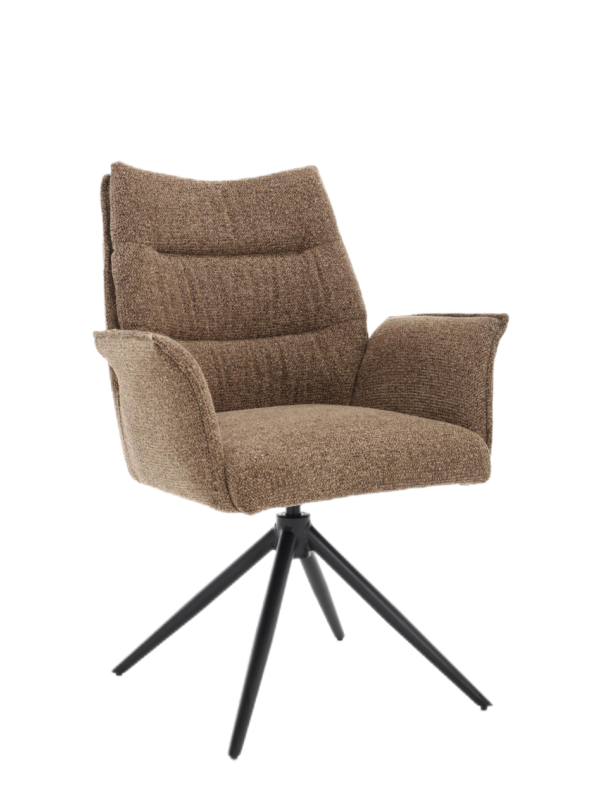
Olleo Furniture is registered for EUDR and works with certified timber in its upholstered seating programs. For European buyers, this means several practical things. First, we specify and document the wood species used in our dining chairs, bar stools, and lounge chairs, and we work with certified forest sources for the solid wood components. Second, we treat documentation as part of the order, not an afterthought: species, origin data, and supporting certificates are compiled per shipment so that your compliance team can file due diligence statements without chasing information.
Our production model also helps compliance planning. With a minimum order quantity of 100 pieces per model (mixable across colors within the same model), a standard lead time of 35 days, and flexible trade terms including FOB Ningbo/Shanghai, EXW, CFR, and CIF, buyers can align procurement cycles with their compliance calendar. For smaller-scale programs, our Olleo Flex made-to-order service starts from as few as 4–6 pieces with 15-day delivery — useful when you want to test a certified-timber model in a specific market before scaling.
Does the EUDR apply to upholstered chairs, or only to solid wood furniture?
It applies to the wood content. An upholstered chair with a beech frame and plywood seat shell is in scope because the wooden components are derived from wood listed in Annex I. Upholstery materials themselves (fabric, foam) are covered only if they fall under other in-scope commodities such as rubber.
Who is responsible for the due diligence statement — the EU importer or the Chinese factory?
The operator established in the EU who places the products on the market is responsible for submitting the due diligence statement and holds the legal liability. Non-EU suppliers like Olleo support the process by providing traceability information, species data, and certified-timber documentation, but the statement itself is filed by the EU operator.
Is FSC certification enough to comply with the EUDR?
FSC and PEFC certification is valuable evidence of legal and sustainable sourcing, and it simplifies risk assessment considerably, but certification alone does not replace the due diligence process. Operators still need geolocation information, a documented risk assessment, and a submitted due diligence statement for each relevant shipment.
EUDR readiness is fundamentally about supply-chain transparency, and the factories that can provide it are the ones worth building long-term programs with. If you are planning upholstered seating for the European market and want a supplier that combines certified timber, EN 12520-tested designs, and EUDR-aware documentation, browse our dining chair collection or sofa range, and contact Olleo Furniture — every inquiry receives a reply within 24 hours.
Contact: Olleo Furniture
Phone: +86-18626211424
E-mail: info@olleofurniture.com
Whatsapp:+86-18626211424
Add: Room 301, Building A, No. 6 Weixin Road, Suzhou Industrial Park, Jiangsu Province, China
We chat